
Model building#
Use liesel.model to describe a statistical model, inspect its dependencies,
and evaluate its log density. A model also lets you calculate predictions and
simulate new responses. Constructing it does not fit its parameters.
This small regression has a normal prior on its coefficients and a fixed response standard deviation:
import jax.numpy as jnp
import tensorflow_probability.substrates.jax.distributions as tfd

import liesel.model as lsl

x = lsl.Var.new_obs(jnp.array([-1.0, 0.0, 1.0]), name="x")

beta = lsl.Var.new_param(
    jnp.zeros(2),
    dist=lsl.Dist(tfd.Normal, loc=0.0, scale=2.5),
    name="beta",
)

mu = lsl.Var.new_calc(
    lambda x, b: b[0] + b[1] * x,
    x,
    beta,
    name="mu",
)

y = lsl.Var.new_obs(
    jnp.array([-0.8, 1.1, 2.9]),
    dist=lsl.Dist(tfd.Normal, loc=mu, scale=1.0),
    name="y",
)
model = lsl.Model(y)
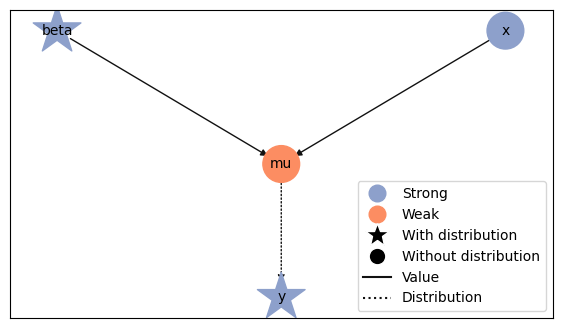
model.plot(width=7, height=4)
round(float(model.log_prob), 3)
-11.557
Model(y) collects the response and its inputs. The value is the
log likelihood plus the log prior at beta = [0, 0]; these are starting
values, not estimates. Pass variables into calculations and distributions so
Liesel can track their dependencies.
Start here#
Common tasks#
For point estimates, continue with Optimization. For posterior sampling, see Sample your first posterior. Arguments and defaults live in the Models.