GEV responses#
In this tutorial, we illustrate how to set up a distributional
regression model with the generalized extreme value distribution as a
response distribution. We configure the model in Python with
Liesel-GAM, using
liesel_gam.TermBuilder for linear terms and P-splines. See the
Liesel-GAM documentation and
examples for a
broader overview of the available term types.
We simulate data from a GEV model with three distributional parameters:
The location parameter (\(\mu\)) is a function of an intercept and a non-linear covariate effect.
The scale parameter (\(\sigma\)) is a function of an intercept and a linear effect and uses a log-link.
The shape or concentration parameter (\(\xi\)) is a function of an intercept and a linear effect.
import jax
import jax.numpy as jnp
import matplotlib.pyplot as plt
import numpy as np
import seaborn as sns
import tensorflow_probability.substrates.jax.distributions as tfd

import liesel.goose as gs
import liesel.model as lsl
import liesel_gam as gam

sns.set_theme(style="whitegrid")
Warning message:
package ‘arrow’ was built under R version 4.5.2
key = jax.random.PRNGKey(13)
n = 500

key, key_x0, key_x1, key_x2, key_y = jax.random.split(key, 5)

x0 = jax.random.uniform(key_x0, (n,))
x1 = jax.random.uniform(key_x1, (n,))
x2 = jax.random.uniform(key_x2, (n,))

true_loc = jnp.sin(2 * jnp.pi * x0)
true_scale = jnp.exp(-1.0 + x1)
true_concentration = 0.1 + x2

y = tfd.GeneralizedExtremeValue(
    loc=true_loc,
    scale=true_scale,
    concentration=true_concentration,
).sample(seed=key_y)

data = pd.DataFrame({
    "y": np.asarray(y),
    "intercept": np.ones_like(y),
    "x0": np.asarray(x0),
    "x1": np.asarray(x1),
    "x2": np.asarray(x2),
    "true_loc": np.asarray(true_loc),
    "true_scale": np.asarray(true_scale),
    "true_concentration": np.asarray(true_concentration),
})
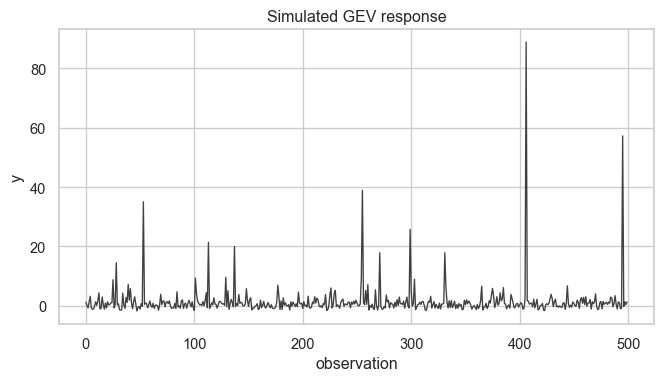
Here is the simulated response:
fig, ax = plt.subplots(figsize=(8, 4))
sns.lineplot(x=data.index, y=data["y"], ax=ax, color="0.25", linewidth=1)
ax.set(xlabel="observation", ylabel="y", title="Simulated GEV response")
plt.show()
We now construct the distributional regression model. The TermBuilder
reads the covariates from a pandas data frame and creates Liesel
variables for the corresponding model terms. The additive predictors are
passed directly to tfd.GeneralizedExtremeValue.
tb = gam.TermBuilder.from_df(data, default_inference=gs.MCMCSpec(gs.IWLSKernel))

loc = gam.AdditivePredictor("loc", intercept=True)
scale = gam.AdditivePredictor("scale", inv_link=jnp.exp, intercept=False)
concentration = gam.AdditivePredictor("concentration", intercept=False)

loc_smooth = tb.ps("x0", k=10)
scale_x1 = tb.lin("intercept + x1")
concentration_x2 = tb.lin("intercept + x2")

loc += loc_smooth
scale += scale_x1
concentration += concentration_x2

# The GEV distribution is numerically delicate around xi = 0, so we start away
# from the Gumbel case while keeping the linear effect initialized at zero.
concentration_x2.coef.value = jnp.array([0.1, 0.0])
concentration.update()

response_dist = lsl.Dist(
    tfd.GeneralizedExtremeValue,
    loc=loc,
    scale=scale,
    concentration=concentration,
)
y_var = lsl.Var.new_obs(data["y"].to_numpy(), response_dist, name="y")

model = lsl.Model([y_var])

# ScaleIG represents tau = sqrt(tau2). The Gibbs kernel samples tau2.
loc_smooth_tau2_name = loc_smooth.scale.value_node[0].name
We use Liesel’s MCMCSpec objects, which are added automatically by
Liesel-GAM, to set up the sampler. The default Liesel-GAM setup uses
IWLS kernels for regression coefficients and a Gibbs kernel for the
smoothing variance of the P-spline.
The support of the GEV distribution changes with the parameter values (compare Wikipedia).
results = gs.LieselMCMC(model).run_for_epochs(
    seed=1, num_chains=4, adaptation=1000, posterior=2500
)
gs.Summary(results)
liesel.goose.builder - WARNING - No jitter functions provided for position keys '$\\beta_{ps(x0)}$', '$\\tau_{ps(x0)}^2$', '$\\beta_{0,loc}$', '$\\beta_{lin(X)}$', '$\\beta_{lin(X1)}$'. The initial values for these keys won't be jittered
liesel.goose.engine - INFO - Initializing kernels...
liesel.goose.engine - INFO - Done
liesel.goose.engine - INFO - Starting epoch: FAST_ADAPTATION, 100 transitions, 25 jitted together
  0%|                                                  | 0/4 [00:00<?, ?chunk/s] 25%|██████████▌                               | 1/4 [00:03<00:10,  3.62s/chunk]100%|██████████████████████████████████████████| 4/4 [00:03<00:00,  1.10chunk/s]
liesel.goose.engine - WARNING - Errors per chain for kernel_00: 1, 1, 1, 1 / 100 transitions
liesel.goose.engine - WARNING - Errors per chain for kernel_03: 2, 0, 0, 2 / 100 transitions
liesel.goose.engine - WARNING - Errors per chain for kernel_04: 3, 4, 2, 2 / 100 transitions
liesel.goose.engine - INFO - Finished epoch
liesel.goose.engine - INFO - Starting epoch: SLOW_ADAPTATION, 25 transitions, 25 jitted together
  0%|                                                  | 0/1 [00:00<?, ?chunk/s]100%|████████████████████████████████████████| 1/1 [00:00<00:00, 1217.86chunk/s]
liesel.goose.engine - WARNING - Errors per chain for kernel_00: 1, 2, 1, 1 / 25 transitions
liesel.goose.engine - WARNING - Errors per chain for kernel_03: 1, 1, 0, 1 / 25 transitions
liesel.goose.engine - WARNING - Errors per chain for kernel_04: 1, 1, 1, 1 / 25 transitions
liesel.goose.engine - INFO - Finished epoch
liesel.goose.engine - INFO - Starting epoch: SLOW_ADAPTATION, 50 transitions, 25 jitted together
  0%|                                                  | 0/2 [00:00<?, ?chunk/s]100%|████████████████████████████████████████| 2/2 [00:00<00:00, 1455.85chunk/s]
liesel.goose.engine - WARNING - Errors per chain for kernel_00: 1, 1, 1, 0 / 50 transitions
liesel.goose.engine - WARNING - Errors per chain for kernel_03: 2, 0, 0, 3 / 50 transitions
liesel.goose.engine - WARNING - Errors per chain for kernel_04: 1, 1, 1, 2 / 50 transitions
liesel.goose.engine - INFO - Finished epoch
liesel.goose.engine - INFO - Starting epoch: SLOW_ADAPTATION, 100 transitions, 25 jitted together
  0%|                                                  | 0/4 [00:00<?, ?chunk/s]100%|████████████████████████████████████████| 4/4 [00:00<00:00, 1801.87chunk/s]
liesel.goose.engine - WARNING - Errors per chain for kernel_00: 1, 1, 2, 0 / 100 transitions
liesel.goose.engine - WARNING - Errors per chain for kernel_03: 2, 1, 0, 1 / 100 transitions
liesel.goose.engine - WARNING - Errors per chain for kernel_04: 3, 1, 2, 1 / 100 transitions
liesel.goose.engine - INFO - Finished epoch
liesel.goose.engine - INFO - Starting epoch: SLOW_ADAPTATION, 525 transitions, 25 jitted together
  0%|                                                 | 0/21 [00:00<?, ?chunk/s] 76%|█████████████████████████████▋         | 16/21 [00:00<00:00, 157.53chunk/s]100%|███████████████████████████████████████| 21/21 [00:00<00:00, 131.69chunk/s]
liesel.goose.engine - WARNING - Errors per chain for kernel_00: 1, 2, 1, 1 / 525 transitions
liesel.goose.engine - WARNING - Errors per chain for kernel_03: 4, 1, 2, 1 / 525 transitions
liesel.goose.engine - WARNING - Errors per chain for kernel_04: 7, 6, 8, 4 / 525 transitions
liesel.goose.engine - INFO - Finished epoch
liesel.goose.engine - INFO - Starting epoch: FAST_ADAPTATION, 200 transitions, 25 jitted together
  0%|                                                  | 0/8 [00:00<?, ?chunk/s]100%|█████████████████████████████████████████| 8/8 [00:00<00:00, 623.89chunk/s]
liesel.goose.engine - WARNING - Errors per chain for kernel_00: 2, 1, 1, 3 / 200 transitions
liesel.goose.engine - WARNING - Errors per chain for kernel_03: 1, 3, 3, 2 / 200 transitions
liesel.goose.engine - WARNING - Errors per chain for kernel_04: 2, 4, 84, 2 / 200 transitions
liesel.goose.engine - INFO - Finished epoch
liesel.goose.engine - INFO - Finished warmup
liesel.goose.engine - INFO - Starting epoch: POSTERIOR, 2500 transitions, 25 jitted together
  0%|                                                | 0/100 [00:00<?, ?chunk/s] 17%|██████▍                               | 17/100 [00:00<00:00, 156.17chunk/s] 33%|████████████▌                         | 33/100 [00:00<00:00, 103.29chunk/s] 45%|█████████████████▌                     | 45/100 [00:00<00:00, 95.92chunk/s] 56%|█████████████████████▊                 | 56/100 [00:00<00:00, 70.69chunk/s] 66%|█████████████████████████▋             | 66/100 [00:00<00:00, 75.90chunk/s] 76%|█████████████████████████████▋         | 76/100 [00:00<00:00, 81.03chunk/s] 85%|█████████████████████████████████▏     | 85/100 [00:00<00:00, 82.51chunk/s] 94%|████████████████████████████████████▋  | 94/100 [00:01<00:00, 83.47chunk/s]100%|██████████████████████████████████████| 100/100 [00:01<00:00, 85.17chunk/s]
liesel.goose.engine - WARNING - Errors per chain for kernel_04: 8, 4, 872, 2 / 2500 transitions
liesel.goose.engine - INFO - Finished epoch
Parameter summary:
| kernel | mean | sd | q_0.05 | q_0.5 | q_0.95 | sample_size | ess_bulk | ess_tail | rhat | ||
|---|---|---|---|---|---|---|---|---|---|---|---|
| parameter | index | ||||||||||
| $\beta_{0,loc}$ | () | kernel_02 | 0.003 | 0.026 | -0.037 | 0.002 | 0.047 | 10000 | 177.883 | 457.979 | 1.021 |
| $\beta_{lin(X)}$ | (0,) | kernel_03 | -1.218 | 0.099 | -1.378 | -1.219 | -1.054 | 10000 | 202.379 | 508.367 | 1.018 |
| (1,) | kernel_03 | 1.400 | 0.137 | 1.172 | 1.399 | 1.623 | 10000 | 307.969 | 865.843 | 1.006 | |
| $\beta_{lin(X1)}$ | (0,) | kernel_04 | 0.071 | 0.110 | -0.061 | 0.074 | 0.255 | 10000 | 8.659 | 50.997 | 1.406 |
| (1,) | kernel_04 | 1.070 | 0.201 | 0.724 | 1.075 | 1.296 | 10000 | 10.591 | 678.843 | 1.320 | |
| $\beta_{ps(x0)}$ | (0,) | kernel_00 | 0.081 | 0.117 | -0.112 | 0.082 | 0.271 | 10000 | 256.969 | 495.439 | 1.029 |
| (1,) | kernel_00 | 0.002 | 0.119 | -0.194 | 0.006 | 0.187 | 10000 | 373.587 | 726.253 | 1.009 | |
| (2,) | kernel_00 | 0.048 | 0.125 | -0.161 | 0.047 | 0.256 | 10000 | 309.323 | 560.738 | 1.005 | |
| (3,) | kernel_00 | -0.008 | 0.110 | -0.185 | -0.005 | 0.163 | 10000 | 328.177 | 556.151 | 1.008 | |
| (4,) | kernel_00 | -0.149 | 0.102 | -0.314 | -0.149 | 0.021 | 10000 | 300.963 | 548.966 | 1.019 | |
| (5,) | kernel_00 | 0.042 | 0.072 | -0.076 | 0.041 | 0.157 | 10000 | 296.677 | 530.711 | 1.021 | |
| (6,) | kernel_00 | -0.357 | 0.048 | -0.437 | -0.356 | -0.281 | 10000 | 303.546 | 527.516 | 1.019 | |
| (7,) | kernel_00 | -0.000 | 0.020 | -0.034 | 0.000 | 0.032 | 10000 | 312.715 | 543.417 | 1.006 | |
| (8,) | kernel_00 | -0.050 | 0.060 | -0.145 | -0.050 | 0.050 | 10000 | 296.621 | 421.972 | 1.025 | |
| $\tau_{ps(x0)}^2$ | () | kernel_01 | 0.031 | 0.022 | 0.012 | 0.025 | 0.068 | 10000 | 1540.702 | 2724.639 | 1.003 |
Acceptance probabilities:
| acceptance_probability | position_moved | |||
|---|---|---|---|---|
| kernel | positions | phase | ||
| kernel_00 | $\beta_{ps(x0)}$ | posterior | 0.828 | 0.823 |
| warmup | 0.793 | 0.792 | ||
| kernel_01 | $\tau_{ps(x0)}^2$ | posterior | 1.000 | 1.000 |
| warmup | 1.000 | 1.000 | ||
| kernel_02 | $\beta_{0,loc}$ | posterior | 0.882 | 0.882 |
| warmup | 0.888 | 0.886 | ||
| kernel_03 | $\beta_{lin(X)}$ | posterior | 0.867 | 0.866 |
| warmup | 0.793 | 0.790 | ||
| kernel_04 | $\beta_{lin(X1)}$ | posterior | 0.848 | 0.848 |
| warmup | 0.791 | 0.793 |
Error summary:
| count | sample_size | sample_size_total | relative | |||||
|---|---|---|---|---|---|---|---|---|
| kernel | positions | error_code | error_msg | phase | ||||
| kernel_00 | $\beta_{ps(x0)}$ | 90 | nan acceptance prob | warmup | 28 | 4000 | 4000 | 0.007 |
| posterior | 0 | 10000 | 10000 | 0.000 | ||||
| kernel_03 | $\beta_{lin(X)}$ | 90 | nan acceptance prob | warmup | 33 | 4000 | 4000 | 0.008 |
| posterior | 0 | 10000 | 10000 | 0.000 | ||||
| kernel_04 | $\beta_{lin(X1)}$ | 2 | indefinite information matrix (fallback to identity) | warmup | 84 | 4000 | 4000 | 0.021 |
| posterior | 872 | 10000 | 10000 | 0.087 | ||||
| 90 | nan acceptance prob | warmup | 58 | 4000 | 4000 | 0.014 | ||
| posterior | 0 | 10000 | 10000 | 0.000 | ||||
| 92 | indefinite information matrix (fallback to identity) + nan acceptance prob | warmup | 2 | 4000 | 4000 | 0.001 | ||
| posterior | 14 | 10000 | 10000 | 0.001 |
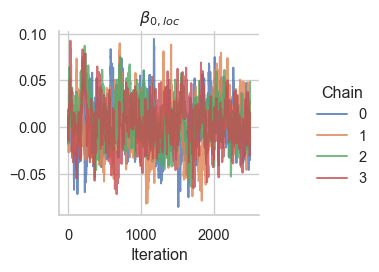
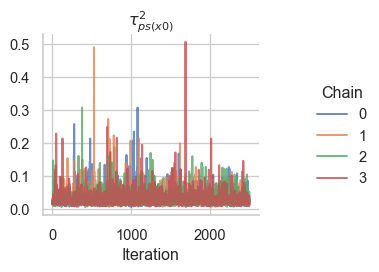
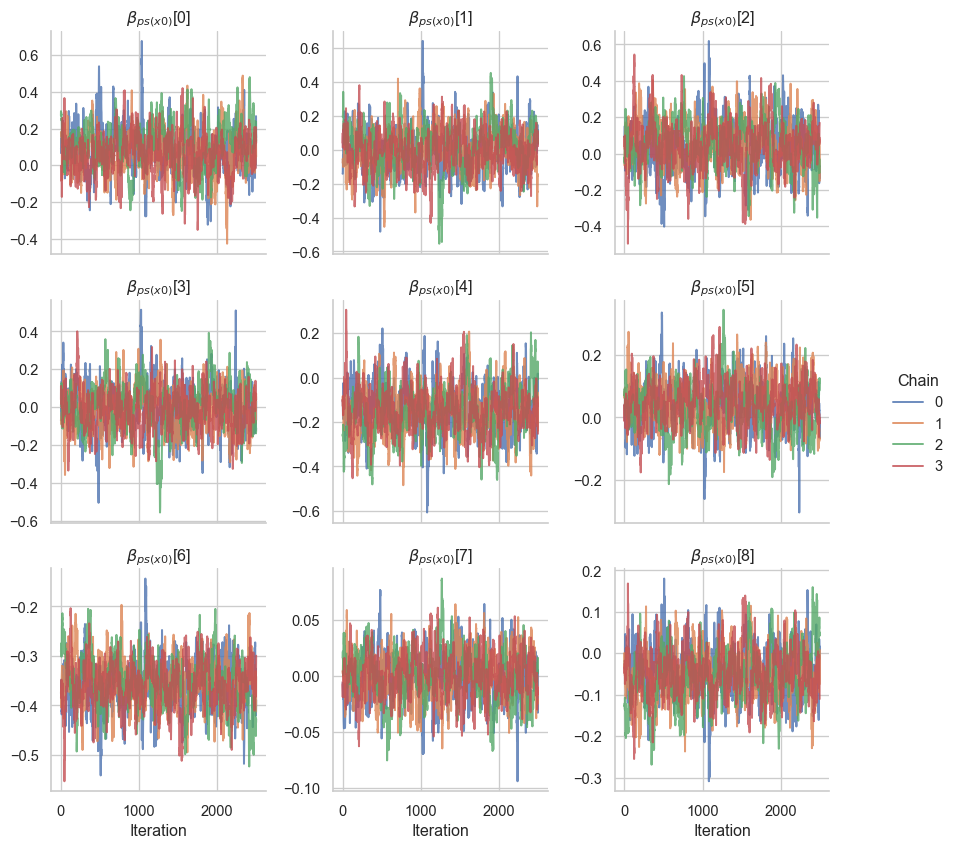
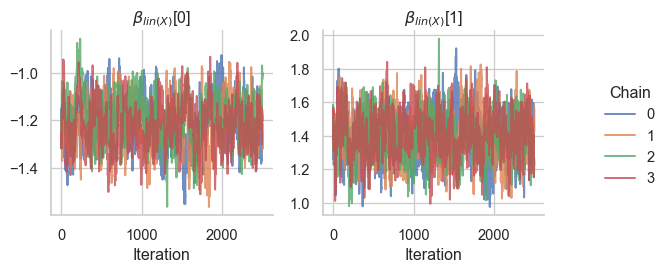
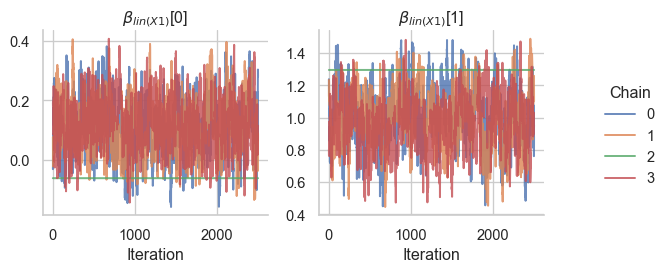
The corresponding trace plots:
gs.plot_trace(results, loc.intercept.name)
gs.plot_trace(results, loc_smooth_tau2_name)
gs.plot_trace(results, loc_smooth.coef.name)
gs.plot_trace(results, scale_x1.coef.name)
gs.plot_trace(results, concentration_x2.coef.name)
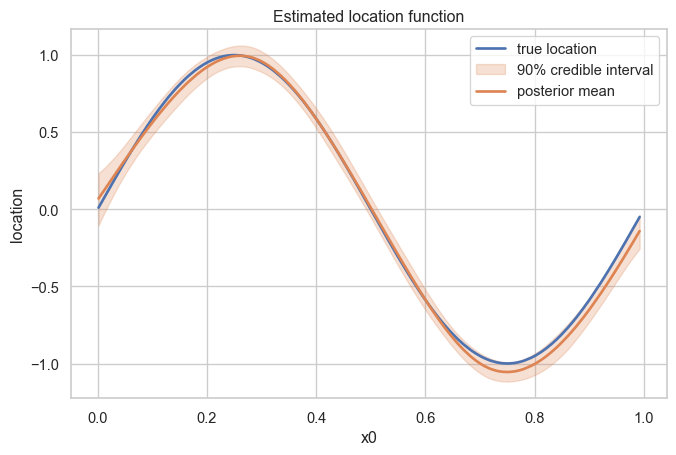
Finally, we can evaluate the posterior samples of the location predictor and compare the posterior mean with the true function used in the simulation.
samples = results.get_posterior_samples()
loc_samples = model.vars["loc"].predict(samples)
loc_summary = gs.SamplesSummary.from_array(
    loc_samples,
    name="loc",
    which=["mean", "quantiles"],
)
loc_summary_df = loc_summary.to_dataframe().reset_index()

loc_summary_df["x0"] = data["x0"].to_numpy()
loc_summary_df["true_loc"] = data["true_loc"].to_numpy()
loc_summary_df = loc_summary_df.sort_values("x0")

fig, ax = plt.subplots(figsize=(8, 5))
sns.lineplot(
    data=loc_summary_df,
    x="x0",
    y="true_loc",
    color=sns.color_palette()[0],
    linewidth=2,
    label="true location",
    ax=ax,
)
ax.fill_between(
    loc_summary_df["x0"],
    loc_summary_df["q_0.05"],
    loc_summary_df["q_0.95"],
    color=sns.color_palette()[1],
    alpha=0.25,
    label="90% credible interval",
)
sns.lineplot(
    data=loc_summary_df,
    x="x0",
    y="mean",
    color=sns.color_palette()[1],
    linewidth=2,
    label="posterior mean",
    ax=ax,
)

ax.set(xlabel="x0", ylabel="location", title="Estimated location function")
plt.show()