Parameter transformations#
This tutorial builds on the linear regression tutorial. Here, we demonstrate how to transform a positive-valued parameter so that it can be sampled with a NUTS kernel on an unconstrained scale.
First, let’s set up the linear regression model again. The data-generating process and the model structure are the same as in the linear regression tutorial, but this time we prepare the model for joint NUTS sampling of the regression coefficients and the error variance.
import jax
import jax.numpy as jnp
import numpy as np
import matplotlib.pyplot as plt

# We use distributions and bijectors from tensorflow probability
import tensorflow_probability.substrates.jax.distributions as tfd
import tensorflow_probability.substrates.jax.bijectors as tfb

import liesel.goose as gs
import liesel.model as lsl

rng = np.random.default_rng(42)

# data-generating process
n = 500
true_beta = np.array([1.0, 2.0])
true_sigma = 1.0
x0 = rng.uniform(size=n)
X_mat = np.c_[np.ones(n), x0]
y_vec = X_mat @ true_beta + rng.normal(scale=true_sigma, size=n)

# Model
# Part 1: Model for the mean
beta_prior = lsl.Dist(tfd.Normal, loc=0.0, scale=100.0)
beta = lsl.Var.new_param(
    value=np.array([0.0, 0.0]),
    dist=beta_prior,
    name="beta",
    inference=gs.MCMCSpec(gs.NUTSKernel, kernel_group="1"),
)

X = lsl.Var.new_obs(X_mat, name="X")
mu = lsl.Var(lsl.Calc(jnp.dot, X, beta), name="mu")

# Part 2: Model for the standard deviation
a = lsl.Var(0.01, name="a")
b = lsl.Var(0.01, name="b")
sigma_sq_prior = lsl.Dist(tfd.InverseGamma, concentration=a, scale=b)
sigma_sq = lsl.Var.new_param(value=10.0, dist=sigma_sq_prior, name="sigma_sq")

sigma = lsl.Var(lsl.Calc(jnp.sqrt, sigma_sq), name="sigma")

# Observation model
y_dist = lsl.Dist(tfd.Normal, loc=mu, scale=sigma)
y = lsl.Var(y_vec, dist=y_dist, name="y")
Now let’s try to sample the regression coefficients \(\boldsymbol{\beta}\)
and the variance \(\sigma^2\) with a single NUTS kernel. NUTS operates on
unconstrained real-valued parameters, whereas \(\sigma^2\) must remain
positive. We therefore biject sigma_sq with an exponential bijector.
This creates an unconstrained latent variable representing
\(\log(\sigma^2)\) and keeps sigma_sq as the positive back-transformed
value. Both beta and the transformed variance receive NUTS inference
specifications with the same kernel_group, so Goose samples them
jointly in one NUTS block.
sigma_sq.biject(tfb.Exp(), inference=gs.MCMCSpec(gs.NUTSKernel, kernel_group="1"))

model = lsl.Model(y)
model.plot()
liesel.model.model - WARNING - Inconsistent log prob decomposition: Model.log_prob=-1177.35 ≠ (Model.log_lik=0.00 + Model.log_prior=-15.72).
liesel.model.model - WARNING - Var(name="y") has a distribution but Var.parameter=False and Var.observed=False.
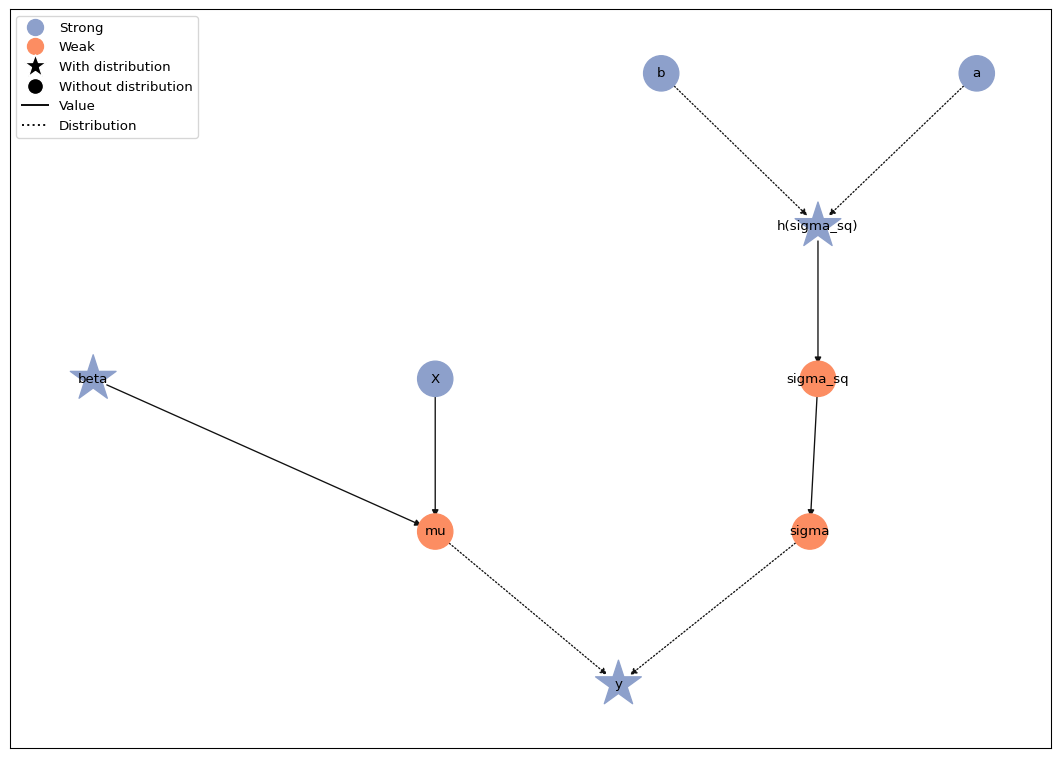
The response distribution still requires the standard deviation on the
original scale. The model graph shows that sigma_sq is now a
deterministic, positive-valued transformation of its unconstrained
latent variable. The standard deviation sigma is then computed as
sqrt(sigma_sq), so the likelihood continues to receive a valid scale
parameter.
Now we can set up and run the MCMC algorithm directly from the
MCMCSpec objects stored in the model. We also include sigma_sq in
the stored positions, because the NUTS kernel itself samples the
transformed variable, while sigma_sq is the easier quantity to
interpret.
results = gs.LieselMCMC(model).run_for_epochs(
    seed=1,
    num_chains=4,
    adaptation=1000,
    posterior=1000,
    positions_included=["sigma_sq"],
)
liesel.goose.builder - WARNING - No jitter functions provided for position keys 'h(sigma_sq)', 'beta'. The initial values for these keys won't be jittered
liesel.goose.engine - INFO - Initializing kernels...
liesel.goose.engine - INFO - Done
liesel.goose.engine - INFO - Starting epoch: FAST_ADAPTATION, 100 transitions, 25 jitted together
  0%|                                                  | 0/4 [00:00<?, ?chunk/s] 25%|██████████▌                               | 1/4 [00:01<00:04,  1.38s/chunk]100%|██████████████████████████████████████████| 4/4 [00:01<00:00,  2.89chunk/s]
liesel.goose.engine - WARNING - Errors per chain for kernel_00: 1, 1, 2, 4 / 100 transitions
liesel.goose.engine - INFO - Finished epoch
liesel.goose.engine - INFO - Starting epoch: SLOW_ADAPTATION, 25 transitions, 25 jitted together
  0%|                                                  | 0/1 [00:00<?, ?chunk/s]100%|████████████████████████████████████████| 1/1 [00:00<00:00, 1240.55chunk/s]
liesel.goose.engine - WARNING - Errors per chain for kernel_00: 2, 1, 2, 1 / 25 transitions
liesel.goose.engine - INFO - Finished epoch
liesel.goose.engine - INFO - Starting epoch: SLOW_ADAPTATION, 50 transitions, 25 jitted together
  0%|                                                  | 0/2 [00:00<?, ?chunk/s]100%|████████████████████████████████████████| 2/2 [00:00<00:00, 1683.78chunk/s]
liesel.goose.engine - WARNING - Errors per chain for kernel_00: 2, 3, 1, 2 / 50 transitions
liesel.goose.engine - INFO - Finished epoch
liesel.goose.engine - INFO - Starting epoch: SLOW_ADAPTATION, 100 transitions, 25 jitted together
  0%|                                                  | 0/4 [00:00<?, ?chunk/s]100%|████████████████████████████████████████| 4/4 [00:00<00:00, 2899.12chunk/s]
liesel.goose.engine - WARNING - Errors per chain for kernel_00: 2, 2, 2, 2 / 100 transitions
liesel.goose.engine - INFO - Finished epoch
liesel.goose.engine - INFO - Starting epoch: SLOW_ADAPTATION, 525 transitions, 25 jitted together
  0%|                                                 | 0/21 [00:00<?, ?chunk/s]100%|███████████████████████████████████████| 21/21 [00:00<00:00, 303.84chunk/s]
liesel.goose.engine - WARNING - Errors per chain for kernel_00: 1, 3, 3, 3 / 525 transitions
liesel.goose.engine - INFO - Finished epoch
liesel.goose.engine - INFO - Starting epoch: FAST_ADAPTATION, 200 transitions, 25 jitted together
  0%|                                                  | 0/8 [00:00<?, ?chunk/s]100%|█████████████████████████████████████████| 8/8 [00:00<00:00, 895.45chunk/s]
liesel.goose.engine - WARNING - Errors per chain for kernel_00: 2, 4, 3, 1 / 200 transitions
liesel.goose.engine - INFO - Finished epoch
liesel.goose.engine - INFO - Finished warmup
liesel.goose.engine - INFO - Starting epoch: POSTERIOR, 1000 transitions, 25 jitted together
  0%|                                                 | 0/40 [00:00<?, ?chunk/s] 80%|███████████████████████████████▏       | 32/40 [00:00<00:00, 307.02chunk/s]100%|███████████████████████████████████████| 40/40 [00:00<00:00, 291.56chunk/s]
liesel.goose.engine - INFO - Finished epoch
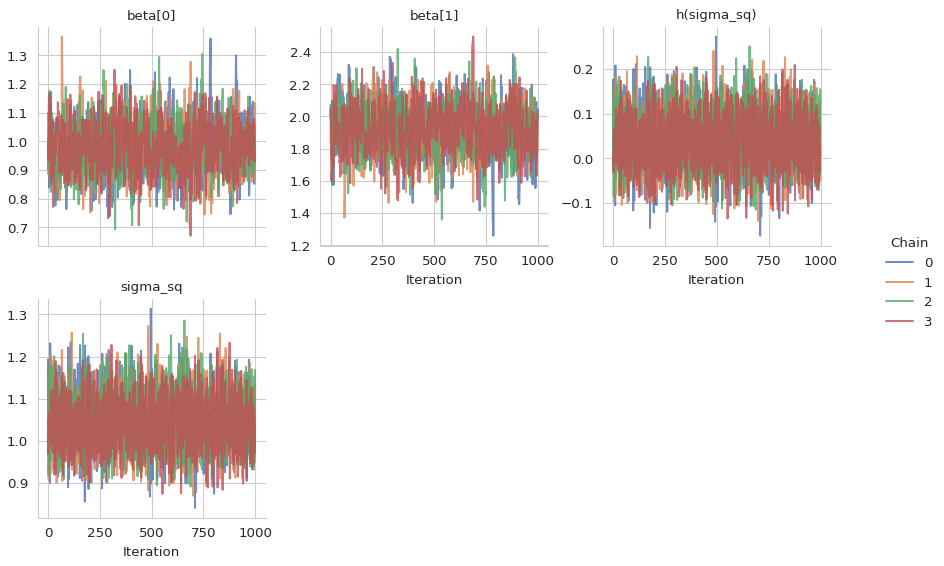
Judging from the trace plots, it seems that all chains have converged.
gs.plot_trace(results)
We can also take a look at the summary table, which includes both the original \(\sigma^2\) and the transformed \(\log(\sigma^2)\).
gs.Summary(results)
Parameter summary:
| kernel | mean | sd | q_0.05 | q_0.5 | q_0.95 | sample_size | ess_bulk | ess_tail | rhat | ||
|---|---|---|---|---|---|---|---|---|---|---|---|
| parameter | index | ||||||||||
| beta | (0,) | kernel_00 | 0.981 | 0.091 | 0.833 | 0.980 | 1.130 | 4000 | 816.958 | 1116.378 | 1.002 |
| (1,) | kernel_00 | 1.914 | 0.159 | 1.656 | 1.916 | 2.173 | 4000 | 772.001 | 917.470 | 1.001 | |
| h(sigma_sq) | () | kernel_00 | 0.042 | 0.062 | -0.058 | 0.040 | 0.145 | 4000 | 5406.551 | 3299.936 | 1.001 |
| sigma_sq | () | \- | 1.045 | 0.065 | 0.943 | 1.041 | 1.156 | 4000 | 5406.532 | 3299.936 | 1.001 |
Acceptance probabilities:
| acceptance_probability | position_moved | |||
|---|---|---|---|---|
| kernel | positions | phase | ||
| kernel_00 | h(sigma_sq), beta | posterior | 0.870 | NaN |
| warmup | 0.791 | NaN |
Error summary:
| count | sample_size | sample_size_total | relative | |||||
|---|---|---|---|---|---|---|---|---|
| kernel | positions | error_code | error_msg | phase | ||||
| kernel_00 | h(sigma_sq), beta | 1 | divergent transition | warmup | 50 | 4000 | 4000 | 0.013 |
| posterior | 0 | 4000 | 4000 | 0.000 |
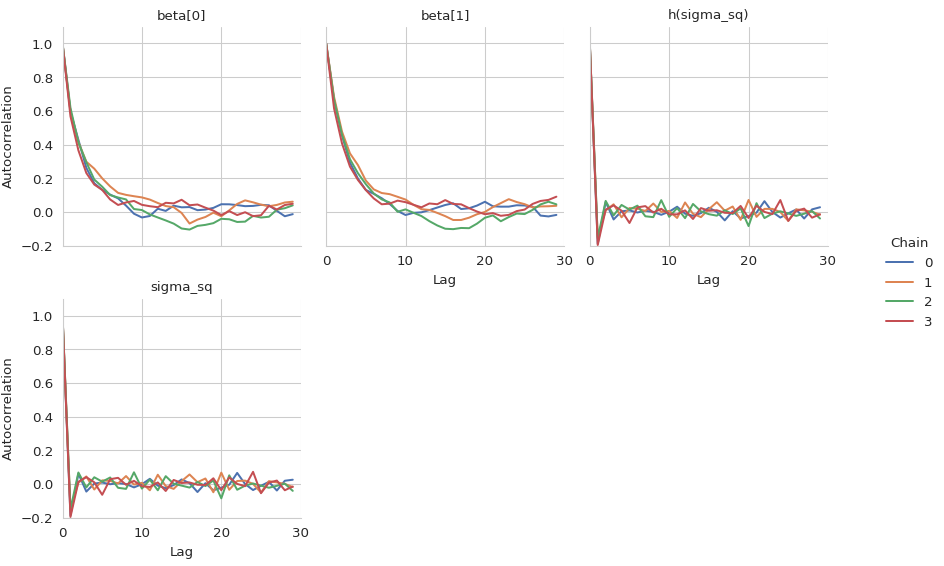
Finally, let’s check the autocorrelation of the samples.
gs.plot_cor(results)